Monday, October 26

On a Favela in Rio de Janeiro

Photo Alexandre Blasifera

This blog is normally about the Iguassu Falls Area. But now and then I go somewhere else and see ans learn things that I feel like sharing. This is the first photograph of a series of a my visit to the Tavares Bastos Community in the area of Catete, Rio de Janeiro.

Monday, October 19

Uruguay's Pluna Air Lines to fly to Iguassu Falls

Friday, October 16


This is a place where the West Paraná Cachaça Producing Cooperative bottles and sells Brazilian Sugar Cane Firewater or simply Brazilian Cacahaça or Brazilian Pinga. I am seen here talking to Cooperative leader Mr. Enio Mendes da Rocha as he explains the whole production process, fro the sugar cane plating, to harvesting, processing it and how it is brought here rest before bottling and selling. I am postng this here because most people coming to the Iguassu Falls Area have no idea about this possibility. Most people, eve Brazilians, will never associate South Brazil to cachaça making. Whenever the drink comes to mind, people will think of Northeast Brazil or rural Minas Gerais and Rio de Janeiro. What is not known here is the fact that German, Italians, Ukrainians and other Europeans adapted to the sugar cane culture and became very good in producing sugar cane products: like sugar and cachaça. So this may be a good opportunity to get to know the area's cachaça.

Wednesday, September 30

A political, cultural, economic, ethnical and social Chronology of the Triple Border

This is a tentative list. Research goes on. If you have something to ask or sugest please feel free to do so. Data from several sources. Still far from what I want to help limajac@gmail.com

1554 Irala arrives to the Lands of the Guayrá
1609 Brazil-based Portuguese ‘Bandeiras’ to guarantee possession of Western Lands
1609 Jesuit priests start catechization of Guarani-Mbya Indians
1620 The Alto Paraná (Py)is an important yerba mate producing region under Jesuits
1638 Portuguese ‘bandeirantes’ invade the Guarani Jesuit Missions of Guayra
1638 Bandeirantes take yerba mate to São Paulo
1765 Count Oyera Pombal asks for permission to found a Military outpost with Py.
1813 Paraguayan Dr. Francia, forbids export of yerba mate.
1853 The State of Paraná becomes autonomous from São Paulo
1865 - 1870 Triple Aliance War (Argentina,Brazil and Uruguay against Paraguay)
1869 Export of yerba mate is authorized in Paraguay
1876 The Serra Graciosa Road is open.Curitiba becomes a yerba mate export center
1879 Particio Escobar y Cia (& Co) granted permission to explore yerba mate in Alto Paraná for 10 years (Py)
1820 French botanist Saint-Hilaire classifies the yerba mate
1880
1881 Severo Fernandez and Ernesto Arnadey buys 50 square leagues of Paraná and Iguazu River land from Corrientes.
1881 Lands are sold to Rafael Gallino who sell them to Gregorio Lezama.
1881 Misiones is separated from Corrientes
1881 Federalization of Misiones
1881 Yerba mate exploit begins in Misiones
1882 Rudecindo Roca sworn in as Misiones first governor
1882 The Mate Laranjeiras Co starts exploiting yerba mate in Mato Grosso
1883 The Alto Paraná Company is born. Patrício Escobar's Concession dies.
1885 Paraguayan Government sells forests and 'yerbales'
1886 The Industrial Paraguaya S.A. is born (Paraguay's 1st huge real estate)
1887 Swiss-born Bertoni arrives to what is now Puerto Bertoni
1888 The Paraná Strategic Comission founded
1888 The popuation of the Mouth of the Iguassu River: 324
1888 Gregorio Lezama sells Iguazu Lands to Martín Erracaborde $ Co.
1889 November, 15, Brazilian Empire dies. Republic proclaimed
1889 The Iguassu Military Colony established
1890
1892 Military Colony is taken off the Strategic Commission
1897 Cap. Edmundo de Barros surveys the Iguassu Falls (BR) and projects a park
1897 Alberto Mugica é designado Juiz de Paz de Iguazu
1900
1901 Misiones Governor Lanusse goes to Buenos Aires to convince the Mihanovich Shipping Co to travel to Iguassu Falls
1901, The first tourist excursion comes to Iguazu on a Mihanovich boat
1902 Carlos Thays surveys the Iguassu Falls AR)and offers Plans for a Nat'l Park
1902 September, 3, the Olmedo Law is passed reserving the Iguassu Falls area to federal administration - thanks to Gov. Lanusse's efforts.
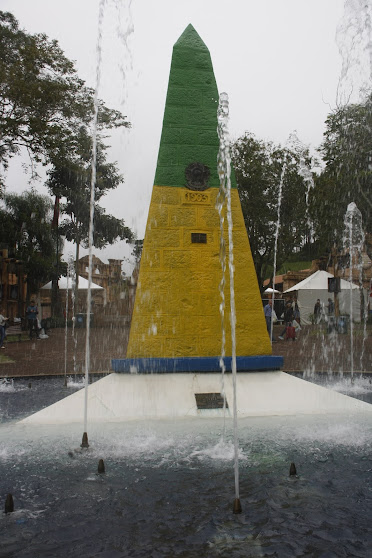
1903 The Brazilian and Argetninean Three-Frontier Landmark dedicated
1905 The Federal Tax Office installed in Iguaçu to be headed by Silveira Netto
1905 The Mate Laranjeira Co. creates a village called Monjoli, today's Guaíra
1906 Police District and Telegraph lines opened in Foz do Iguassu
1907 The Iguazu lands divided and sold at an auction. Domingo Arrayagaray bought the North part and Martin Errecaborde secured the Southern portion .
1907 The Gibaja y Nuñez MIning Co. builds the first hotel in Iguazú.
1912 Military Colony is dismantled. Powers handed over to the State of Paraná
1913 Governent buildings in Puerto Iguazu: Police, Subprefectura, School
1914 World War II begins
1914 June, 10, Foz do Iguaçu is born as Villa Iguassu
1916 First Notary Public opens in Puerto Aguirre
1916 April 24, Brazilian Air Hero Santos Dumont visits Puerto Aguirre (Puerto Iguazu's former name). He was coming from a PanAmerican Aviation Congress held in Santiago, Chile. He visited Buenos Aires and embarked on a tour to the Falls.
1916 Aviator and Santos Dumont crosses the river and visits the Falls from the Brazilian side and stay at a Hotel on Avenioda Brasil (Foz's first) and sleeps a night at shelter by the Falls.
1916 Santos Dumont learns that the Falls were privately owned and promisses to travel to Curitiba and talk to the State President and sugest the creation of a Park. He eventually goes meets the president. Three months later the state starts the process o acquire the 1.008 hectares of land around the Iguassu Falls (Br)
1916 The Government of the State of Paraná declares the land around Iguassu Falls as of Public Interest based on a 1912 law. The owner, a Sapniard named Jesus Val takes government to court.
1919 Jesus Val accepts a deal to sell the land to the State of Paraná
1923 German-born Catholic Father Guilherme Maria Thiletzek, Foz's first, arrives in town.
1924 Whole population of Villa Iguassu seek refuge in Puerto Aguirre runnning from the Revolutionary Advance Column led by Isidoro Dias Lopes. Invaders were kicked out by Marshal Cândido Rondon
1928 Argentina buys the lands of Arrayagaray in order to create a National Park and Military Zone.
1929 Puerto Franco, Paraguay is founded as the seat of an Obraje
1932 The Brazilian Military returns to Foz do Iguaçu (guassu Falls). This time a 152-soldier strong Army Isolated Company was formed. The Army's return to the border!
1932 – 1935 The Chaco War. Paraguay and Bolivia goes to war over the Chaco Region.
1934 Army's Headquarters inaugurated.
1935 Law 12.103 (AR) creates the Parque Nacional Iguazú (Iguazu Nat'l Park -AR)
1935 Iguassu Falls' First Airfield opens. Lt.Aroldo Rodrigues flew the forst plane in.
1937 Brazilian Federal Government builds a large wooden Cataratas Hotel. On May,2,the building is lost to fire. It is said that someone tryed to incinerate a beehive.
1938 The Municipality of Tacurupucu (PY) is created as a 3rd Category Municipality
1939 World War II Begins
1939 Brazil Presidente Getulio Vargas signs a Decree creating the Parque Nacional do Iguassu (Iguassu National Park).
1941 Limits for the Iguazu (Argentina) National and the city are agreed upon
1941 Foz do Iguaçu Airport Building opens by the the 1935 airstrip. Official name: Aeroporto do Parque Nacional do Iguassu (Iguassu national Park Airport).
1943 Federal Government creates the Iguassu Federal Territory. The capital was to be (but never was) the city by the same name. That was a bite of Paraná State Lands.
1943 The 1st Border Battalion created.
1944 The First Government Delegation on the Paraguayan side opens at Itakyry
1946 The Iguassu Federal Territory is dismantled. The Getulio Vargas dictatorship fell one year before.
1950 First Lebanese immigrant comes to Foz do Iguaçu
1954 Stroessner comes to power after a coup he called "revolution"
1955 Brazil-Paraguay commission to build "the road" conectoing the two countries
1956 Maio 26, Agreement to build an International Bridge signed
1956 June,10, COnstruction Act is signed
1957 Florida Hassan El Nassr,first child of Arab descent is born in Foz do Iguaçu.
1958 Syrian-Brazilian Cultural Associatons created
1959 February, 3, Aeroporto Alejo Garcia Inaugurated in Paraguay
1960
1962 First Arab marriage in Foz do Iguaçu.
1961 Jan 26, Inauguration of the Paraguayan Three-Frontier Mark
1965
1966
1977 1st FARTAL
1980 Arab-Palestine-Brazilian Society created
1981 The Foz do Iguaçu Islamic Beneficent Society is founded
1981 The Foz do Iguaçu Islamic Beneficent Cutural Center is founded
1981 Corner Stone for the Omar Ibn El Khatab is laid down
1982 Brazilian Arab School innaugurated using dependencies of the Mosenhor Guilherme State School
1983
1985 Universidad Nacional del Este (Paraguay) brings first University Course to Eastern Paraguay
1986 The first FERNATEC Fair is launched
1988 The President Stroessner (Ciudad del Este) Bus Staion Rodoviária CDE
1989 The Estadio Tres de Febrero (Februry 3rd Stadium) innaugurated.
1992 Lady Di, Helmut Kohl and other dignitiaries visited Foz do Iguaçu
1992 First Department governors dedicated aaccording to new 1992 Paraguay Constitution
1993 ABAV (Brazilian Association of Travel Agents)congress hed in Foz do Iguaçu
1994 The Druze Brazilian Home of Foz do Iguaçu opens
1996 Arab Brazilan School opens
1998 The Arab Brazil Beneficent Assocation opens
1999 Copa América (America Soccer Cup) held in C.del Este.
1999 Arab Brazilian Evangelical Church founded
2001 Lebanese Brazilian School first to introduce Arabic as curriculum language
2009 Oct,18, Foundation stone for the Foz do Iguaçu Druze Brazilian Home laid down.
2009 November, Arab Brazilian School's First High School Class graduates.

Monday, July 6

Andes Airlines Flight connects Iguazu to Salta


This is just to let you know that ANDES Airlines has been sucessfully flying out of the Iguazu Falls (Puerto Iguazu) Airport to Salta on the Argentine Northwest (NOA) region. The flight leaves Iguazu at 3:30 pm and ther flight only takes 1h40 minutes. I just been there and back and have fallen in love with the area. I am happy that the flight is here. I will be glad to tell a little more about my tour to Salta and Jujuy!

Tuesday, June 9

Shamanic Ceremony and Music presentation at Iguassu Falls Area


The photo and video above have been made on Saturday, June 6th, at the deck of Porto Caonas Restaurant and Cultural Area overlooking Iguassu Falls. The occasion was a musical presentation by the Degraded Sons of Eve Choir and Band made up by members of the Portal do Sol (Sun's Door) Shamanic Studies Center. Also, later on, same day, there was a beautiful and hard-to-describe shamanic ceremony geared at opening the Iguassu Falls Peace Portal and set the Creative Mist for Peace and abundance to the rest of the Planet. Iguassu Falls is revered as a Sacred Place and as a powerful Earth Chacra.

Sunday, May 31

Candomblé and Umbanda Festivities and holidays


Photo of artistical rendering of a Preto Velho - Old Negro Slave - taken from the Raiz Cultural (Cultural Roots) Blog

The dates first:

January 20 - Oxóssi
April 23 - Ogum
May 13 - Pretos Velhos (Old Negroes)
June 13 - Xangô
July 26 - Oxum
September 27 - Saints Cosmas and Damian
October 12 - Erê Children's Fest
November 02 - Omulú
November 15 – Umbanda’s Foundation
December 04 - Iansã (Yansan)
December 12 - Iemanjá (Yemanja)
25/12 - Oxalá


Now some words on the dates:

These are not holydays in the sense that shops close, children do not go to school and offices normally do not have to open. These are more internal celebrations or festivities held in Umbanda and Candomblé ‘terreiros’ or centers. These special days are dedicated to one Orisha (Orixá). But two main dates above mark important events inside and outside umbanda. May 13 is the day when Brazilians celebrate Slavery Abolition Day. It is the day when Princess Isabel signed the law setting all slaves free.

The Umbanda tradition celebrates the Preto Velho Day, the Old Negro Slave Day. The second important date for all Brazilians is November 15, the Day the country celebrates the Republic Proclamation Day also known as Dia da Bandeira or Flag Day. The Black Brazilian Umbanda Nation celebrates the Umbanda’s Foundation Day. Last but not least there is a third interesting date. November the second when Christianity with a few exceptions celebrate the Dia dos Finados or Dia de los Muertos or All Souls' Day.

The Afro-Brazilian religion as a religion of the oppressed used these days to protest, tough silently and cunningly, the injustices committed and the nearsighted, single-minded solutions offered like the mainstream society idea that freedom was given by the princess and not fought over bravely and very costly in lives and suffering by the negroes for over 100 years. Nearsighted because the end of slavery was the beginning of a free life of suffering where the only choice available was the choice of which miserable place he or she or the family choose to die? Millions of free negroes took to the streets of a poor country, of city and urban misery. Something similar to the land enclosure measures in England prior and through the industrial revolution.

That mass of homeless migrating people marked the beginning of Brazilian-style ‘favelas’ with dispossessed former slaves climbing the ‘morros’, hill and mountains to hide in their makeshift shacks. In this sense it is interesting to highlight that Brazilian Negro Movements do not accept or celebrate Slavery Abolition Day neither on May 13 or under that name. They celebrate the end of slavery of sorts on November 20, which marks the date of Zumbi's death. Zumbi is the Afro-Brazilian anti-slavery hero who fought Portuguese, French and Dutch for nearly 100 years.

Zumbi was the leader of Quilombo dos Palmares Brazil’s largest and most successful quilombo in what is today the State of Alagoas. It was a community-republic of slaves who fled their owners and got ready to fight back and liberate fellow slaves. The Quilombo was finally subdued by Domingos Jorge Velho a “badeirante” Indian slave raider and gold prospector from São Paulo. The Bandeirantes were also responsible for the destruction of the Jesuit Missions in this region of Southern Brazil, Northeastern Argentina and Southern Paraguay. What a link!

The last date is a good example of religious adaptation when Brazilian slaves took advantage of the holiday not to celebrate the dead according to the Catholic Church but to honor Omulu the orisha responsible for protecting cemiteries and holy fields.

Soon to come:
Plan a visit!
What is an Orisha?

Paraguayan Side Holidays

January first - New Year's Day
February 3th - Ciudad del Este Anniversary on Saint Blas Day
March 1st - Day of the Heroes (Death of Marshall Lopez)
March - Holy week and Easter
May 1st - Workers' Day
May 15th - Independence Day
May 24th - Anniversary of the Patron Saint of the Province (Maria Auxiliadora)
June 12th - Peace of the Chaco Day
August 15th - Foundation of Assuncion
September 29th - Boquerón Battle Day
December 8th - Our Lady of Caacupé Day
December 25th - Christmas Day

Brazilian Side Holidays

January 1st - New Year's Day
February or March - Carnival (movable)
April - Holy Week and Easter (movable)
April 21st - Tiradentes Day National Independence Hero
May first - Labor Day
May or June - Corpus Christi
June 10th - Anniversary of Foz do Iguacu (Iguassu Falls City)
June 24th - St John the Baptist's City's Patron Saint
September 7th - Independence Day
October - 12th - Our Lady Aparecida's Day (Brazil's Patron Saint)
November 2th - All Souls' DayThe Day of the Dead
November 15th - Republic Proclamtion Day
December 25th - Cristmas

Argentinean Side holidays

January first - New Year's Day
March 24 National Day of Memory and Justice
April - Holy Week and Easter
April 2 Malvinas (Falklands') War Day
May first - Workers' Day
May 25th - Country's First Government Day
June 20th - Flag Day
July 9th - Independence Day
August 17th - San Martín Day
September 10th - Anniversary of Puerto Iguazu
October 12th - Day of Razas (Races) Columbus Day
December 8th - Virgin of the Immaculate Conception Day
December 25th - Christmas Day

Thursday, May 28

Buying Values: what to take that is local?


Foto from Marisa's Con Nuestras Manos Blog
Ñanduti embroidery is a typical good example of a Paraguayan-made handicraft. The word ñanduti means web. It is not native of Ciudad del Este but comes from all over Paraguay mainly from the city of Itaguá. Paraguayan pottery, silver jewelry and wood carving are also great. If you like music a Paraguayan Harp might be a good idea.


I will come back with more

Business hours in the Tri-Fron

This is serious business. I am working on this information. But I will venture the following:

Foz do Iguaçu

On the Brazilian side shops are open from 8h a.m. to 6h p.m.
Office hours normally from 8h a.m. to 12h and from 1h or 2h p.m. to 6h p.m.
Supermarkets and shops forbidden to open on Sundays. Restaurants downtown mostly close by 2h.

Puerto Iguazu

Shops and offices will open from 8h a.m. to 12h and from 4h p.m. to 08 p.m. Siesta time is a must. Exception major supermarkets, bus station, and vital services police, border patrol though some officer do dose a little. Dining time late (11h p.m. onward to 2 a.m.)


Ciudad del Este
Ciudad del Este's is a bit more complex.
The 'Microcenter' or the 'city heart' visited mostly by Brazilian shoppers has opening hours of its own and does not follow official Paraguayan opening and closing times. Shops and other businesses tending to the Brazilian public opens as early in te mornig as possible. It is not unusual to see shops open at 5 p.m. Closing time for shops in the 'microcenter' starts around 3 p.m. By 4 p.m. street vendors, smalls stands and saller shops will be either closed or closing. This is not true for bigger shops and shoppings catering to five-star type of tourist clients and shoppers. Some of these shops will open up to 10 p.m. But and this is some but, these are special arrangements. Check before going. Outside this microcenter enclave the Ciudad del Este of normal Paraguayans follow the national opening and closing hours which includes making a stop afer lunch and being back around 3h. Paraguayans Siesta time is becoming shorter than the Argentine one.

When to come and what to bring?

Anytime. I live here year round. If you come in November, December, January and February may be all the way to May be ready to sweat very seriously. Temperatures are high. You may have the feeling that you might be cooked alive. May is the month when our winter comes into place. Thinking mythologically, God (Ñamandu) created the world and himself in the dark night of winter while he sat in the middle of the original winds. Original Winds is nearly synonym of winter. Temperatures drop and there are quite a few rainy days with very cold rains. If you don't mind that's OK.


What to bring?

We only have two very clear seasons: summer and winter. Winter may be cold and rainy. Be prepared for cold weather, hot weather, wet weather all in the same day maily from May through August. In the summer, a hat is needed, light clothes are a good idea. I will come back with more....

I'm working on this