Index to postings
Secrets to Bus in the Triple Border - TTU
Bus to Três Lagoas via Rodoviária
Bus Rodoviaria via INSS, IML and Police Quarter
Bus to Brazil-Paraguay Amizade Bridge
The Universitária Line
Bus to Morumbi and Greater S.Francisco Area
Theme-Street Bairros – Portal da Foz and Morumbi
Bus to the Iguaçu National Park (INP)
Bus to INP / Argentina Intersection
Bus to INP Brazil’s Shortest Highway – BR 469
Bus to INP Price Democracy or Discriminatory Mess?
Bus to the Vilas of Itaipu
Bus to Três Bandeiras, Libra and Lote Grande
Bus to Vila “A” skipping the INSS-IML
Bus to Vila “C” and Bela Vista Biological Refuge
Bus to the Three Border Stone Mark (Wait for this)
Non-Integrated Local Bus - Interbairros City Tour
Non-Integrated Metro Bus – Bus to Santa Terezinha
Non-Integrated Metro Bus – Bus to S. Miguel
Non-Integrated Metro Buses – Tips on a trend
Non-integrated Intl Metro Bus/ to Puerto Iguazu
Non-integrated Intl Metro Bus / to Paraguayan cities
Non-Integrat’d Intl Metro Bus–Puerto Iguazu to Paraguay
Non-Integrat’d Intl Metro Bus to Puerto Franco, Paraguay
Bus Puerto Iguazu to Falls, Argentina
Bus Puerto Iguazú – Bernardo Irigoyen (Special Line)
Showing posts with label bus. Show all posts
Showing posts with label bus. Show all posts
Thursday, December 13, 2007


Public Bus in the Triple Border Intro

Sign on JK Avenue telling pedestrians not to get into the TTU through here (Author's photo)
Moving around by public bus in the Triple Border Area of Argentina, Brazil and Paraguay
The secret of moving around by bus in Foz do Iguaçu is to understand how the – Pedro Antonio de Nadai Urban Transport Terminal or just TTU works. The TTU occupies a sizeable area in downtown Foz do Iguaçu between Avenida Juscelino Kubitscheck (JK) – running roughly South-North, and the Rua Tarobá where the Bosque Guarani Municipal Zoo is located. On an East-West course, the TTU is squeezed between the Travessa Luiz Gama and the Rua (Street) Mem de Sá.
If you remember that millions of Brazilians survive on a minimal monthly misery wage that only now, after hundreds of years of struggle, has just bordered on the USD 150 mark, paying R$ 2.00 for a bus ride in town to be taken to and from work, twice a day, is a lot of money (some people say it is a theft). The TTU has been created as a way to cut down part of that spending. Thanks to the TTU’s Transporte Integrado (Integrated Transportation) concept you can take a bus from the Airport in Foz do Iguaçu, get off at the TTU and board a second bus “free” to another area of the city. Integrated buses are identified by either a white-lettered sign on the bus’ “forehead” or on a small black or white-lettered , handpainted (emergency) small sign located somewhere easy to see in the bus anatomy – preferrably the front of the vehicle.
As I have already mentioned, the official and only entrance to the TTU is on the JK Avenue. The back of the TTU is located strategically across from the entrance to the Park Guarani City Zoo (in case you want to visit).
The sides of the TTU are limited by the Rua Mém de Sá (Street) to the North and by Travessa Luiz Gama to the South. The TTU’s neighbor on its front side is the Fortified and electrified wall of the 34th Motorized Infantry Batallion – 34th BIMTZ, for short. The TTU lies between Foz do Iguaçu’s center proper and the Vila Paraguaia – a little Paraguayan enclave dating back from the glorious days of General Stroessner’s dictatorship (1954 – 1988). Guarani is understood by most of the older people and Spanish is (hopefully) understood by all. Also nearby on the JK Avenue is the Muffato Supermarket – strategically explored by backpackers from the whole world. Backpackers go their for mineral water and food. Something that is very interesting is that the 34th BIMTZ is called The Batalhão Republica do Paraguai (Battalion Republic of Paraguay) and is located on the Avenida República Argentina.
On more than half a dozen special days, the BIMTZ receives authorities from both Argentina and Paraguay. I dare to say that if you want to hear the Paraguayan or Argentine national anthems well sung with voices that hold the right tune from beginning to end you should listen to them as they are sung by Brazilian soldiers accompanied by the BIMTZ’s military band. Well I don’t think I will be beheaded because of this remark. Will I? Now let me go back to safer ground and concentrate on the TTU.
Bus to Três Lagoas via Rodoviária

PLATAFORM ONE / SIDE ONE
Bus to Três Lagoas via Rodoviária
The TTU has three driveways and four plataforms. The platform on the Rua Mem de Sá is the one with the greatest amount of bus services offered – some of them of interest to the international public. Starting from the stop closest to the JK Avenue, there are buses that serve the regions of Tres Lagoas (Three Lagoons), Gleba Guarani and Jardim Dourado. At least two of these buses will either stop at the Rodoviaria Internacional de Foz do Iguaçu (International Bus Station)or stop pretty close to it. These are bus lines used by the population of these highly populous “bairros” or neighborhoods of Foz do Iguaçu. But besides the local population, these busses are very popular with backpackers of all kinds (Australians, New Zealanders, Israelis, Germans, Canadians, Americans, Japanese).
They are also popular with Brazilian tourists, Argentineans and Paraguayans returning from Brazilian beaches and many more. Since these buses have been meant for the local population they can be overcrowded with workers between 7 and 8 o’clock in the morning (in the neighborhood – city center direction), and 4 to 6 pm in the city center - neighborhood direction.
I have seen groups of Israelis or Europeans with huge back-breaking backpacks boarding these buses in these critical hours. I have never seen local people spitting on tourists or raising hell because of the confusion created by the rather educational and culturally enriching act of seeing huge backpacks made to fit a crowded bus. This is something positive about the people in Foz do Iguaçu. I really like to see how local people try to talk to travelers, teach them how to negotiate the turnstiles and how much the ticket costs besides trying to tell them where the bus stop is when the time to get off has come. I am sure that the situation would not be the same if those involved were middle class Brazilians, those who never ride on buses – including most of the people in town made richer and richer by tourism. The city has a rather serious problem with violence, thefts, robbery and murders – but I am very thankful to the local bandit and criminal community for leaving tourists out of our mess. Thank you all!
The buses going to Três Lagoas and Gleba Guarani besides making a stop at the Rodoviaria (Bus Station) they also will drive by and stop at or near several good hotels in town: Best Western Falls Galli, Recanto Park, Rafain Palace and Muffato Plaza Hotel (the same Muffato as the Supermarket).
The Rafain Palace Hotel has what may be the city’s largest convention and congress area and many of these events bring a lot of people to town and many guests are generated for hotels all over the city. So it is not difficult to see convention and congress participants using the local bus transportation service between the Rafain and their hotels and vice-versa. One note though: buses serving the rodoviaria (bus station) are of two kinds. Those going to the actual rodoviaria building and those passing near the rodoviaria along the Avenida Costa e Silva – an avenue I sometimes refer to as the Motel Avenue or Avenue of Motels. Prefer those buses with a sign saying that the bus will take the Avenida Paraná – INSS route.
Bus to the Amizade Bridge

Bus to Brazil-Paraguay Friendship Bridge
Back to the living world of the TTU, following this platform you will see signs announcing buses that will go to the Ponte da Amizade (Puente de la Amistad or Friendship Bridge), Jardim America and Jardim Itaipu. There are a few numbered lines: 110/ 125/ 130/ 325/ 355. Where will they go? Mostly to neighborhoods that you may not have the time or interest to see – right now. Buses going to the Ponte da Amizade (Bridge) are very important to the city. They are the physical conection between Foz do Iguaçu (Brazilian) and Ciudad del Este (Paraguayan). They are also the link between the Brazilian State of Paraná and the Paraguayan Departamento (Department like the French) of Alto Paraná. Needless to say that he Bridge is above all a bridge between Brazil and Paraguay. Most of the buses stopping at this “Bus Stop” come from areas like Porto Meira (that is where the Three Borders’ Landmark, Jardim das Flores (Flower fo Gardens) and Profilurb, all in the Greater Porto Meira Area. Up to now thousands of Brazilian (Iguassuan) wage earners have to cross the border to work as for Paraguayan shops in all kinds of jobs and in varying degrees of informality or formality. A sad reality!
Buses to Três Lagoas Lake Beach via INSS, IML, Police Quarter and Rodoviária (Bus Terminal)
INSS, IML and Police Quarter Foto of IML / INSS
As far as buses to Três Lagoas are concerned there is still one going to the Praias (Beaches). Beaches? Sure, artificial beaches created by man on the shores of the Itaipu Lake (Reservoir). The bus going to the “Praias” or “Prainha” (little Beach) will also go to the Rodoviaria if there is a sign saying that the route is via Rodoviaria and the INSS. If you are not Brazilian it’s possible that you will have a hard time trying to translate what INSS stands for. It’s simple: Instituto Nacional de Seguridade Social (Social Security National Institute).
In this case INSS is a bulding where poor and weary iguassuans spend long hours on never-ending lines, waiting. People line up for retirement papers, to get different benefits, pregnancy benefits, death benefits, to see an INSS doctor, to get certifiicates of all kinds besides getting various precious stamps. The INSS has another special characteristic: it is always on strike. I don’t know how social security works in your place, but I know that I am very thankful for the fact that you will nor need the INSS – unless you have migrated to Brazil and accepted to share our crosses and burdens and yokes. The area where the INSS building is located is a very busy bus stop. People get off here to go the City’s main Health Post and Hospital.
Hundreds of people also have to visit the Brazilan Receita Federal (Internal Revenue, Customs and Tax all together) Office mostly trying to reclaim goods mostly caught or confiscated by Customs at the International (Paraguay-Brazil)Friendship Bridge.
Also served by the same bus stops there, is the IML and the 6th Subdivison of the State Civil Police both under the umbrella of the Paraná State Secretary of Security. The Civil Police is called civil because it is not organized in the military way. No corporal, sargeant, colonel, no uniform. Today’s governor Roberto Requião has tried to impose neckties on civil police man. He said that it is for them look good. I think it is not fair to make healthy men wear neckties in Foz do Iguaçu in January. Besides neckties are suspicious, here. Unless he is in court, in a conference or in a Mormon chapel, someone wearing a necktie is propably doing something wrong. Watch Out! Unfortunately, you may need the Civil Police. It is the police office that you will have to go to in order to register a complaint about something (bad) that has happaned to you. Example: your backpack has been stolen. Passport stolen. Money. Whatever crime has been commited against you, you will have to come to the Civil Police. It is the first step of the ladder to access the Judiciary System.
If someone is going to go jail this is where it all begins. The exception is for federal crimes and those crimes regulated by international conventions: drug smuggling, transporting of drugs, explosives, terrorism (wherever it is) and the smuggling and trafficking of people across international borders. Like that? Normally after people are heard by Civil Police authorities they are sent to a State Jail called “Cadeião” that has the reputation to be very bad, overcrowded and highly dangerous. It is the greatest violation of the laws of physics that states that two bodies can not occupy the same space. At the the Cadeião built for 300 souls, more than 800 bodies pay for their sins of their owners in this purgatory called Cadeia Estadual de Três Lagoas (Three Lagoons State Jail). People are suposed to remain here until judgement. But many have been forgotten there. Human Rights activists should take a tour of the Tres Lagoas Jail as a side tour of the Iguassu Falls trip.
Very close to the Policia Civil’s 6th Subdivision there is yet another state organization called IML that stands for Legal Medical Institute (Instituto Médico Legal). By Legal Medicine we are saying Forensic Medicine which means that the IML houses the “Morgue”, forensic investigators and scientific criminal investigation experts. Don’t be scared if I say that there is a possibility that living people may need the services of the IML. The Forensic Institute is also used to officially attest that torture, physical aggression, physical violence like rape or even the loss of virginity and so on has happened or has not happened to someone.
This procedure is called “exame de corpo delito” roughly an examination to attest the truth or not of a claim related to violence of any kind to someone's body. So the IML is not for the dead alone even though a coroner may do the testing. If you find yourself in some situation when someone titled coroner comes to check you, don’t doubt the fact that you are alive and not dead in hell or paradise.
Neo-Metropolitan buses

Sign with timetable for the Foz do Iguaçu - São Miguel Metropolitan Bus (Author's photo)
METROPOLITAN
Recently the Government of Paraná has been intent on creating metropolitan areas with an eye on improving administration. Foz do Iguaçu is a candidate to be decared a metropolitan are for a number of cities mainly those bordering on the Reservoir of Itaipu. This has been the flag of local politicians. The problem is that the Government saw things otherwise and had planned to put Foz do Iguaçu under the umbrella of Cascavel. How that will end is something to wait and see.
In the practical side of life what has alredy been seen is the formation of a network of metropolitan bus lines. The neo-metropolitan bus lines when compared to old experiments like the STI bus line.
You can take metropolitan buses to San Miguel do Iguaçu and Santa Helena from the stop at Rua Mem de Sá, by the TTU Terminal in Foz do Iguaçu. Again these buses are not integrated so they do not enter the TTU. But they can be taken from Men de Sá Street by the Restaurant Corujão. It is possibe to board them also from the Rodoiária (Bus Station on the platform used by local buses)
The difference between these buses and the long distance intermunicipal buses is that these have common, non-reclinable seats, the ticket is paid in the bus, and they stop whenever someones signals at or think of signalaing at them along the BRs (Federal Highways) and PRs (Paraná State Roads).
Between Foz do Iguaçu and Santa Helena (on the shores of the Reservoir of Itaipu) the bus will drive through Santa Terezinha de Itaipu, São Miguel do Iguaçu, Itaipulândia and Missal. The first leg of the trip is Foz do Iguaçu - São Miguel.
Bus to Puerto Iguazu - Argentina


TO PUERTO IGUAZÚ – ARGENTINA
The terminal for buses coming from Puerto Iguazú (to Foz do Iguaçu) is around the area of the International Friendship Bridge. When they leave the Bridge Area they stop and can be boarded at any of the bus stops along the Avenida JK. Important for people in hotels along the avenue like the Lider Palace Hotel. The bus stops by the TTU on Rua Mem de Sá right beside the Lanchonete Corujão (Big Owl). Do not forget that to go to Puerto Iguazu you will need to carry your passport and have the right visas in case citizens of your country needs visa. If you are Brazilian, only official documents are accepted, i.e. RG (Carteira de Identidade) or Passport. No other. No kind of professional document like Lawyers’ (OAB) ID, Military Papers, Politicians’ Identification. Nothing. Just RG or Passport.
I have seen Argentina’s Migration Agents turning down Brazilian Ministers, Deputados (Congresmen), and even the Paraná State Secretary of Segurança (Security) was sent back to his hotel to get his Brazilian (RG) ID. Brazil will soon have to start to tighten things up. Paraguay too.
Buses to Argentina are part of the International Urban Transportation. If you have trouble understanding something that is “International Urban” you are not alone. This concept is older than the International Metropolitan. Two Argentine bus companies operate the Puerto Iguazú – Foz do Iguaçu – Puerto Iguazú line. They are the locally-owned Transportes Tres Fronteras and the Posadas-owned Crucero del Norte ( Crucero also travels to São Paulo, Rio, Buenos Aires, La Plata, Bariloche and Santiago)
There are also two Brazilian companies operating on the same stretch: Viação Itaipu and Celeste (part of Pluma bus) What I am going to say now is a secret and understandably some people don’t like it. Crucero del Norte charges R$ 2.00 or $ 2.00(Argentine pesos). The remaining trio Itaipu, Celeste and Tres Fronteras charge R$ 3.00 or $ 3.00 pesos. Crucero del Norte’s bus tend to be better, wider, easier to move around with luggage. Itaipu sometimes use a micro bus with doors too narrow for people to get in with the added problem that the turnstile is right by the door. This is the worst for the handicapped. Definitely impossible for wheelchairs. None of the international buses offers accessibility for wheelchairs users. What is the message?
You have to get off at the Brazilian Federal Police Immigration Control. Buses normally will not wait. So, the driver will give you a small piece of paper, a ticket, that you can use in the next bus. But tickets are not interchangeable. They have to be used in buses of the same company. Remember the R$ 3.00 – R$ 2.00 deal? This is revenge time!
It is possible that you will lose the bus again on the Argentine Immigration Control area. The same will be done. A ticket so that you can board the next bus. All buses will go to the International Bus Terminal of Puerto Iguazu.
On the Puerto Iguazú – Foz do Iguaçu stretch, buses depart from the International Bus Terminal. Remember that you have to go through immigration and stamp your passport out.
Be careful when you enter Brazil. Situation in Brazil is more laid back, relaxed and that is bad. It is possible that you will not see a police man and some drivers will drive slowly but straight through the control area. It means that you are illegal. Some people may stay illegally during their whole stay in the Border and only be awaken to reality when they try to leave Brazil from Rio, São Paulo. Some drivers are very good in trying to guide passengers in the right direction. Also remember that if there is a long line it is better to get off the bus with your gear and take the next bus.
Bus to Paraguayan border cities from Foz do Iguaçu


BUS TO PARAGUAY
Three Paraguayan cities are served by the International Urban Transportation system: Ciudad del Este, Hernandárias and Ciudad Presidente Franco. The companies involved are Celeste and Irmãos Rafagnin from Foz do Iguaçu, Rápido Yguazu S.A. (RYSA) and Nuestra Señora de la Asunción (NSA),Chaco Boreal and Trans Paranaense (From Paraguay).
The first four travel between Foz do Iguaçu and Ciudad del Este (CDE) and basically cross the downtown area of both cities including the business/shopping area.
The Ciudad del Este – Foz do Iguaçu - Ciudad del Este line offers two different routes. The first links the CDE’s International Bus Terminal to the Foz do Iguaçu International Bus Terminal. The second links the CDE’s Bus Terminal to the Vila Iolanda area of Foz do Iguaçu near the Restaurant China, Churrascaria Rafain and the like.
Chaco Boreal only goes to Hernadarias (the seat of Itaipu Dam, Paraguayan side) and the Trans Paranaense goes to Ciudad President Manuel Franco. Franco for short, is where the Monday Falls are located. Besides it houses the Moisés Bertoni Scientific Monument (a category in the Paraguayan National Park System). The Paraguayan Three-Border Stone Mark is also located here. Few tourists or no tourists at all visit Franco. So do not expect much in the way of comfort. Also, it is good to remember not to go alone to the Monday Falls or the Paraguayan Three-Border Stone Mark.
On the Brazilian side, bus stops for these lines are found along Avenidas Cataratas, Costa e Silva, República Argentina, Jorge Schimmelpfeng (Avenues), Rua Almirante Barroso and JK near the TTU), on the sidewalk of the 34th BI MTZ and the Rodoviária.
The International Bus Terminal of Ciudad del Este offers buses to the whole of Paraguay, as well Brazil, Argentina and Uruguay. More on this later.
Tuesday, March 06, 2007
Public Bus in the Iguaçu Tri-Junction Area - Brazilian Side (I)


The secret of moving around by bus traveling in Foz do Iguaçu is to understand the – Pedro Antonio de Nadai Urban Transport Terminal or just TTU (Drawing above). The TTU occupies a large area in downtown Foz do Iguaçu between the Avenida Juscelino Kubitscheck – running roughly South-North and the Rua Tarobá where the Bosque Guarani Municipal Zoo is located. On an East-West course, the TTU is squeezed between the Travessa Luiz Gama and the Rua (Street) Mem de Sá. The map above gives you a general idea of where Foz do Iguaçu is located. It shows Foz do Iguaçu (Brazil), Ciudad del Este (Paraguay) to the right of Foz do Iguaçu across the Paraná River, Puerto Iguazu (Argentina) to the South across the Iguassu River, Hernandárias to the North of Ciudad del Este and to the West, Santa Terezinha de Itaipu.
If you remember that millions of Brazilians survive on a minimal monthly misery wage that now after hundreds of years of struggle has just bordered on the USD 150 mark, paying R$ 2.00 for a bus ride in town to be taken to and from work, twice a day, is a lot of money. The TTU has been created as a way to cut down part of that spending. Thanks to the TTU Transporte Integrado (Integrated Transportation) concept you can take a bus from the Airport in Foz do Iguaçu get off at the TTU and board a second bus “free” to another area of the city. So the important word here is INTEGRATED. There are a few non-integrated bus lines, i.e, buses there are not in this system both covering some city lines and metropolitan lines serving a few towns in the Foz do Iguaçu area. There are international metropolitan buses or international urban lines that leave Foz do Iguaçu to Puerto Iguazú (Argentina), Ciudad del Este (Paraguay), Ciudad Presidente Franco (Paraguay) and Hernandárias (Paraguay).
Must of the buses that will be of interest to backpackers from most countries are in the integrated category. Here is a list:
Bus to Itaipu – Vila C Norte-Sul / Conjunto C /
Bus to Itaipu’s Bela Vista Wildlife Refuge
Bus to Iguassu Falls / Parque Nacional – via Aeroporto (National Park via Airport
Bus to the Three-Country-Three-River Meeting Point (Porto Meira)
Prainha de Três Lagoas – Três Lagoas Beach (on the Itaipu Lakeshore)
Buddhist Temple - Jardim California
CEAEC (Jardim Copacabana) Conscientiology Campus
Mosque - Take bus going to Rodoviaria, INSS
Universitária Line (Goes to Unioeste and Uniamerica campi)
Local Non-Integrated Buses
Interbairros - if you have some time to spare this line is a city tour!
Feeder bus - this operates only in and around thr Paudimar Youth Hostel
Non-Integrated Metropolitan Lines
To Santa Terezinha de Itaipu (Company is Viação Itaipu)
To São de Miguel do Iguaçu (Company is Princesa dos Campos)
To Itaipulândia and Santa Helena (Along the shores of the Itaipu Reservoir on the Brazilian side)
International Lines
Puerto Iguazu
Ciudad del Este
Hernandárias
Thursday, October 26, 2006
Bus on fire
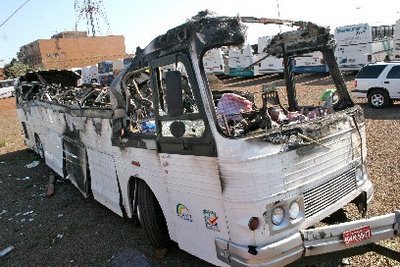
Photo by Nei de Souza
People don't accept the war against smuggling very easily. They do fight back. Above I posted one of my friend Nei's photos showing a bus burnt by a group of very upset people. Many buses and cars have been burnt. Like this one.
Subscribe to:
Posts (Atom)
Featured Post
The Único Rechargeable Bus Card for Tourists: feel like the locals
Image from Agência Comtato Attention all Free Independent Travelers (FIT) and whomever likes to use local transportation and s...

-
 Photo of artistical rendering of a Preto Velho - Old Negro Slave - taken from the Raiz Cultural (Cultural Roots) Blog The dates first:...
 -
 Mission accomplished. Members of the Mãe Edna de Baru's (Mother Edna of Baru) house. An Afro-Brazilian Religious Space may ...
 -
 Photo from the US Embassy Brazil's FLICKR Gallery showing Eleanor Roosevelt, with Natal's Bishop Marcolino Dantas and General Gome...